We Make Tax Filing A Breeze
Home » US Navigating Form 5472: The Essential IRS Filing for Foreign-Owned US Businesses

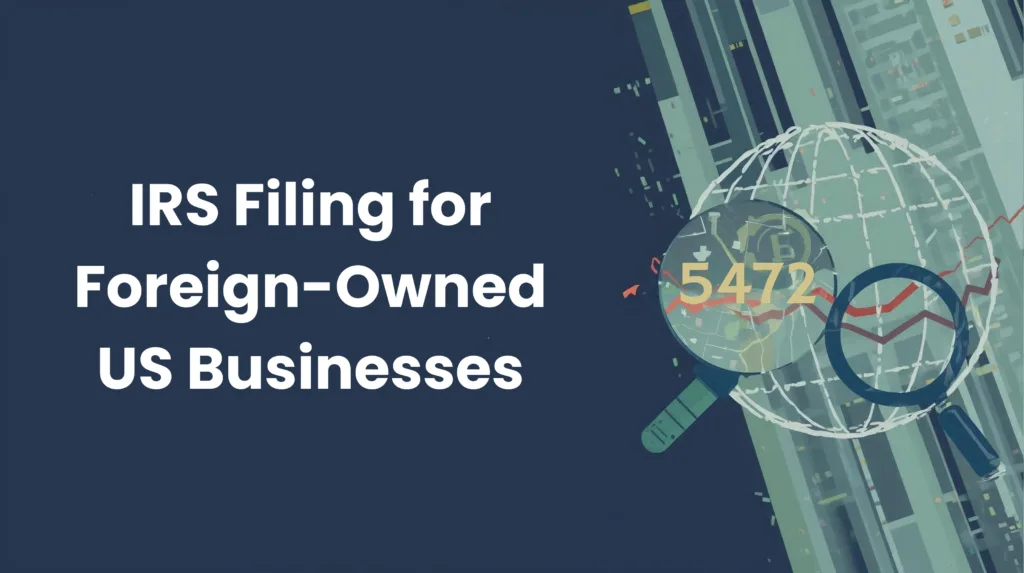
As an international entrepreneur or business looking to establish a presence in the United States, forming a US entity whether an LLC, C-Corp, or S-Corp is a vital first step. However, US corporate formation comes with specific and often complex tax and information reporting requirements, especially when the ownership is foreign.
Chief among these international compliance obligations is IRS Form 5472, which focuses on transactions between a US business and its foreign owner. Missing this filing or filing it incorrectly can lead to severe and immediate penalties.
This comprehensive guide from TheTaxBooks, experts in US tax for international clients, breaks down everything you need to know about Form 5472 to ensure your business remains compliant and avoids costly errors.
IRS Form 5472, Information Return of a 25% Foreign-Owned U.S. Corporation or a Foreign Corporation Engaged in a U.S. Trade or Business, is a mandatory informational return.
Its primary purpose is to provide the Internal Revenue Service (IRS) with transparency regarding transactions that occur between a foreign-owned US entity and its foreign related parties. This is part of a global effort to prevent profit shifting and ensure proper tax allocation under Transfer Pricing rules.
For foreign investors, understanding this form is not optional it is essential for compliance and the continued legal operation of your US business.
The obligation to file Form 5472 rests on the Reporting Corporation. The IRS defines a Reporting Corporation as one of two types of entities:
A US corporation is considered 25% foreign-owned if, at any time during the tax year, it has at least one direct or indirect foreign shareholder that owns 25% or more of the total voting power or the total value of all classes of its stock.
Key Term: A “foreign person” includes a non-resident alien individual, a foreign corporation, a foreign partnership, a foreign trust, or a foreign estate.
This is where the rules become complex for many international investors, particularly those who choose an LLC structure.
In clear terms: A US single-member LLC owned 100% by a foreign individual or foreign company must file Form 5472 if it engages in reportable transactions with its foreign owner or related parties.
A Reporting Corporation must file Form 5472 for each related party with which it has engaged in a reportable transaction during the tax year.
A “related party” typically includes the 25% foreign shareholder and any other person or entity related to that shareholder or the Reporting Corporation.
Reportable Transactions are broadly defined and include almost any monetary or non-monetary exchange of value between the US entity and its foreign related party.
These are the most common types of transactions that must be disclosed on Form 5472:
If your US entity, even a single-member LLC, simply receives a capital contribution from its foreign owner to open a bank account or pay initial expenses, it has engaged in a reportable transaction and is required to file Form 5472.
Form 5472 is an attachment and must be filed along with the reporting corporation’s income tax return by the same due date (including extensions).
A crucial detail for foreign-owned LLCs:
A foreign-owned disregarded entity (like a single-member LLC) is typically exempt from filing an annual US income tax return (like Form 1040-NR or Form 1065). However, to fulfill the Form 5472 reporting mandate, the LLC must file Form 5472 attached to a pro forma Form 1120.
The pro forma Form 1120 is essentially a basic, skeleton corporate return used only as a transmittal form for the attached Form 5472 and does not calculate corporate tax liability.
The penalties for failure to file Form 5472 (or filing it incomplete/inaccurate) are severe and apply regardless of whether any tax is due.
The penalty is a minimum of $25,000 for each year the form is not filed.
Furthermore:
These steep penalties emphasize that Form 5472 is a high-priority compliance issue for any foreign-owned US business.
While Form 5472 is critical, foreign-owned businesses may have other mandatory international information reporting requirements, including:
The intricacies of international tax compliance, from determining your filing status to preparing and submitting the correct forms like Form 5472 and the related pro forma Form 1120, require specialized expertise. Mistakes are costly and expose your business to severe financial risk.
At TheTaxBooks, led by Principal Consultant Kishore Chennu, MBA CMA, EA-IRS (US), specialize in guiding businesses and individuals from across the globe through the entire process from US Company Formation to meticulous Bookkeeping & Accounting and essential Federal and State Tax Filing. We simplify the complex rules surrounding foreign-owned entities, ensuring you achieve and maintain full compliance.
Focus on growing your business; let us handle the complex US tax and information reporting.
To learn more about how you can reduce your taxes and save money, check out the helpful resources on our blog or contact us today to schedule a consultation.