We Make Tax Filing A Breeze
Home » 2026 Compliance Guide for Private US C-Corporations: Taxes, Governance, and New Rules

For international entrepreneurs and US expats, operating a private C-Corporation in the United States offers significant prestige and access to the world’s most robust capital markets. However, the regulatory landscape is far from static. As we move through 2026, several major legislative shifts including the “One Big Beautiful Bill Act” of 2025 and updated FinCEN reporting rules have fundamentally changed the compliance checklist.
Maintaining “Good Standing” is not just about avoiding IRS penalties; it is about protecting your personal assets and ensuring your business remains a viable vehicle for growth.
Federal compliance remains the cornerstone of your annual obligations. For the 2025 taxable year, most C-Corporations must address their filings in early 2026.
Domestic C-Corps report income, gains, and deductions via Form 1120. For calendar-year corporations, the deadline is April 15, 2026. If you require more time, an extension can move this date to October 15, 2026.
Crucially, the IRS requires corporations to pay taxes as they earn income. Quarterly estimated tax installments are generally due on the 15th of April, June, September, and December. Missing these can trigger underpayment penalties that compound over time.
A major highlight for 2026 is the impact of the “One Big Beautiful Bill Act,” enacted on July 4, 2025. This law reinstated the ability for companies to immediately expense domestic research and experimental (R&E) expenditures.
Previously, companies were forced to amortize these costs over five years. This change is a significant win for tech-heavy startups and private companies investing in innovation, allowing for immediate tax deductions that improve cash flow.
Compliance doesn’t end with the IRS. Each state operates as its own regulatory island.
Annual Reports: Most states require a “Statement of Information” to confirm management and address details.
Franchise Tax: States like Delaware and California charge a franchise tax regardless of whether the company turned a profit. In California, even an inactive business is generally subject to an $800 minimum tax.
Registered Agent: Your agent is your legal “mailbox.” If you lose your registered agent, you risk losing your “Good Standing” status, which can paralyze your ability to open bank accounts or sign contracts.
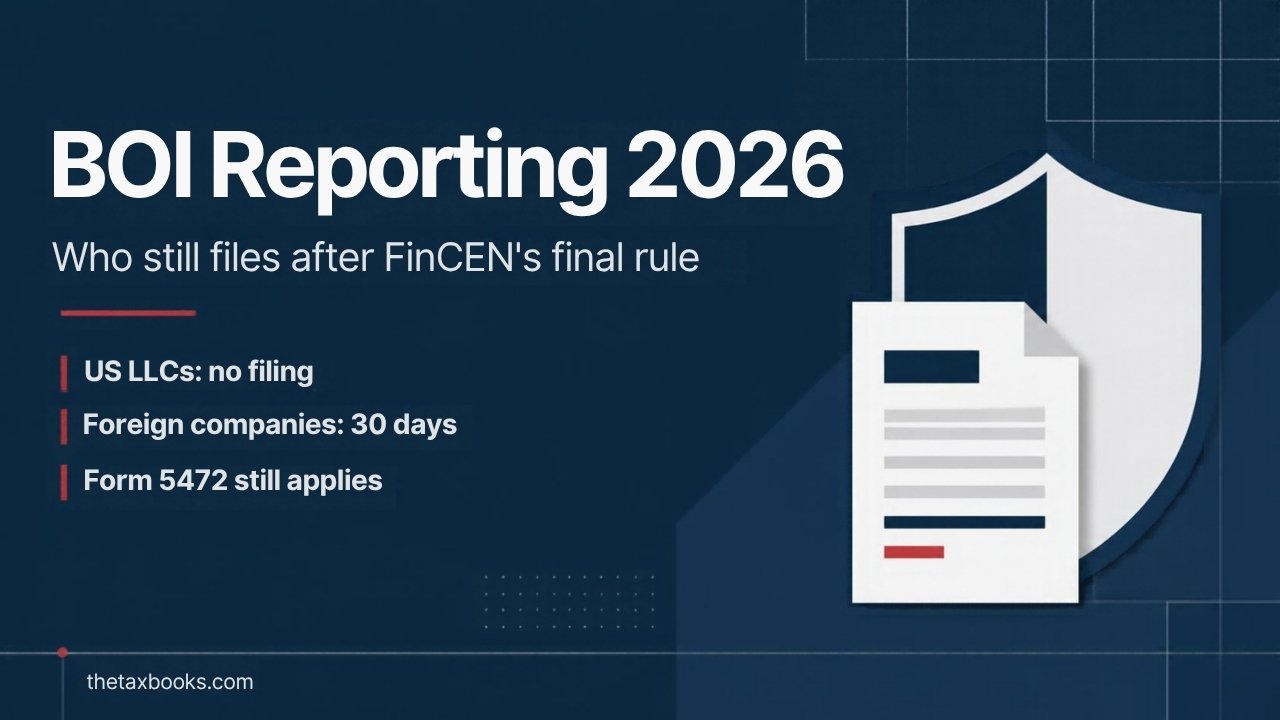
One of the most significant regulatory updates occurred on March 21, 2025. Under a FinCEN interim final rule, domestic U.S. C-Corps are now exempt from Beneficial Ownership Information (BOI) reporting under the Corporate Transparency Act.
However, there is a catch: This exemption applies to domestic entities. Foreign entities registered to do business in the U.S. are still required to report. This distinction is vital for international founders to understand to avoid unnecessary filings or missing mandatory ones.
If your U.S. C-Corp is 25% or more foreign-owned, your compliance burden increases significantly. You are required to file Form 5472 to report transactions between the corporation and foreign related parties (such as the owner or a parent company abroad).
Expert Alert: The IRS treats Form 5472 with extreme strictness. The penalty for failing to file this form or even filing it with incomplete information is $25,000 per form, even if the company had zero income.
At TheTaxBooks, led by Kishore Chennu (IRS Enrolled Agent), we frequently assist international clients in navigating these high-stakes forms to ensure every cross-border transaction is disclosed correctly.
A C-Corp is a separate legal person. To keep that “veil” of protection between your business debts and your personal bank account, you must follow corporate formalities:
Board & Shareholder Meetings: You must hold and document at least one annual meeting for each.
Corporate Resolutions: Major moves like opening a new bank account or appointing an officer must be documented in writing.
Stock Ledger: You must maintain a real-time record of who owns what shares.
If a court finds you have “commingled” personal and business funds or ignored these formalities, they may “pierce the corporate veil,” making you personally liable for the company’s liabilities.
Labor Laws: With remote work now standard, you must comply with payroll tax laws in every state where your employees reside. This includes issuing W-2s and 1099s by January 31 each year.
Data Privacy: If you have customers in California or the EU, you may fall under the CCPA or GDPR. Compliance is no longer optional for small businesses handling consumer data.
Record Retention: We recommend keeping federal tax records for at least 7 years. Digital storage is acceptable, provided it is robust and accessible during an audit.
| Date | Deadline / Obligation |
| Jan 31 | Issue W-2s to employees and 1099s to contractors. |
| Apr 15 | Form 1120 Annual Tax Return (or extension) & Q1 Estimated Tax. |
| Jun 15 | Q2 Estimated Tax Payment. |
| Sep 15 | Q3 Estimated Tax Payment. |
| Oct 15 | Final deadline for Form 1120 (if an extension was filed). |
| Dec 15 | Q4 Estimated Tax Payment. |
| Ongoing | State Annual Reports, Board Minutes, and Registered Agent renewals. |
US tax and corporate laws are designed to be rigorous. While the “One Big Beautiful Bill Act” has provided welcome relief for R&D-heavy companies, the penalties for missing international disclosures like Form 5472 remain a major risk.
Whether you are an Indian startup incorporating in Delaware or a US expat managing a domestic entity from abroad, TheTaxBooks provides the expertise needed to navigate these complexities. From company formation to complex federal and state filings, we ensure your business remains compliant so you can focus on growth.
To learn more about how you can reduce your taxes and save money, check out the helpful resources on our blog or contact us today to schedule a consultation.