We Make Tax Filing A Breeze
Home » IRS Forms W-9 vs W-8BEN: When to Use Each & Common Mistakes

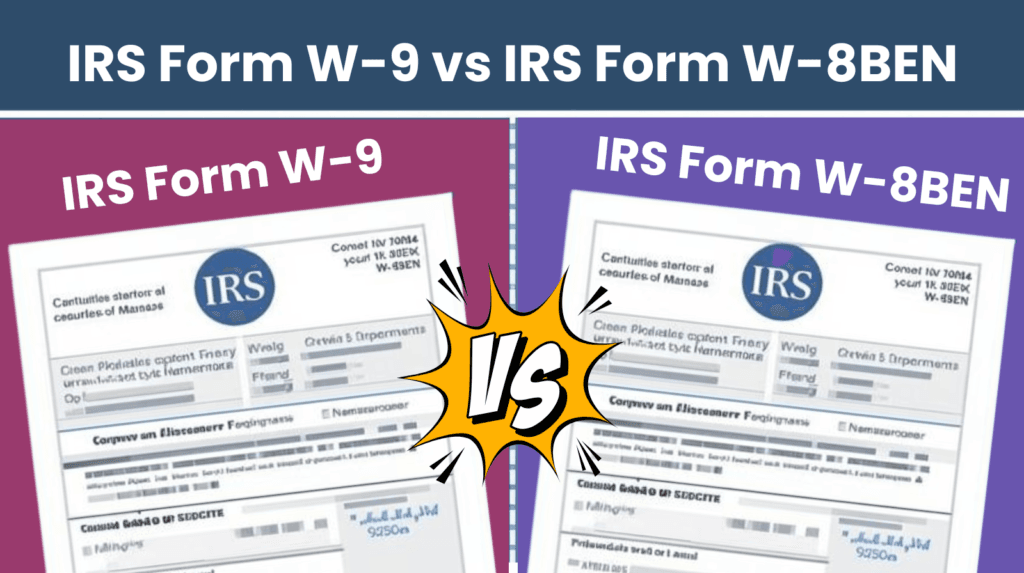
For any individual or business receiving income from a U.S. source, correctly completing IRS tax forms is the essential first step toward compliance. Among the most commonly confused documents are Form W-9 and Form W-8BEN.
Choosing the wrong form can result in anything from excessive, unnecessary tax withholding to severe penalties and non-compliance issues for both the payee (recipient) and the payer (withholding agent). This is particularly true for our target audience: international businesses looking to incorporate in the US, foreign investors, and US expats living abroad.
As experts in US Tax Filing and US Company Formation, TheTaxBooks understands the complexity involved. This authoritative guide will clearly define the distinction, explain when each form is required, and highlight the common pitfalls we see international clients fall into.
Both forms serve the same primary function for a U.S. payer: to properly document the payee’s tax status so the payer knows whether to withhold tax from the payment, and at what rate.
The difference lies entirely in the payee’s tax identity:
Using the correct form ensures compliance with Chapter 3 of the Internal Revenue Code (IRC), which governs withholding on payments made to foreign persons, and prevents inappropriate Backup Withholding which might otherwise occur.
Form W-9, Request for Taxpayer Identification Number and Certification, is only for individuals and entities who are considered a U.S. person for tax purposes.
The purpose of the form is twofold:
A U.S. payer receiving a W-9 typically does not withhold tax (unlike the standard 30% rate applied to non-residents). Instead, the payee is responsible for reporting that income and paying any required U.S. income tax on their annual tax return.
The definition is broader than just living in the US. A U.S. person includes:
Form W-8BEN, Certificate of Foreign Status of Beneficial Owner for United States Tax Withholding and Reporting (Individuals), is for individuals who are not U.S. persons.
The form confirms three critical pieces of information to the U.S. payer:
If a payment is considered Fixed or Determinable Annual or Periodical (FDAP) income (like dividends, royalties, rent, or certain interest) and is made to a foreign person, the U.S. payer generally must withhold tax at a flat 30% rate.
By submitting a properly completed W-8BEN, the individual can:
For foreign entities (corporations, partnerships, etc.), the correct forms are typically variations of the W-8 series, such as Form W-8BEN-E (for foreign entities).
When a U.S. entity or individual asks you to complete a tax form, use this simple rule:
Question | Answer | Required Form |
Are you a U.S. Person? (U.S. Citizen, Green Card Holder, Resident Alien, or Domestic Entity) | YES | Form W-9 |
Are you a Foreign Person? (Non-Resident Alien or Foreign Entity) | NO | Form W-8BEN (or W-8BEN-E) |
The complexity of US international tax law is where mistakes often occur. Many individuals who feel foreign (because they live abroad) are, in the eyes of the IRS, still U.S. persons and are providing the incorrect certification.
This is perhaps the biggest point of confusion. A non-citizen who holds a U.S. Green Card (Lawful Permanent Resident status) is automatically considered a U.S. Person for tax purposes, regardless of where they physically live.
The Fix: A Green Card holder must provide Form W-9, not W-8BEN, unless they have formally and legally relinquished their Green Card status through specific procedures.
A U.S. citizen, even if they hold citizenship in another country (dual national) and have never lived in the U.S. (Accidental American), is still considered a U.S. Person subject to worldwide taxation.
The Fix: U.S. citizens must always use Form W-9 to certify their U.S. status and provide their SSN.
For our international business clients incorporating in the US, the entity type is crucial:
The correct classification of a foreign-owned U.S. LLC is a specialized area of tax law. Getting this classification wrong affects not only the W-9/W-8 form used but also the required annual filings, such as Form 5472 for certain foreign-owned U.S. entities.
Navigating the nuances of US Company Formation and ensuring proper tax status from day one is a core component of our expertise. TheTaxBooks helps international entrepreneurs structure their businesses correctly to ensure compliance with all federal and state requirements.
Using the correct certification form is a fundamental step in US tax compliance. Failure to do so can result in over-withholding, under-withholding, or trigger compliance problems for the U.S. payer, which can complicate your ongoing business relationship with them.
Given the complexities involved especially concerning residency tests, dual citizenship, and the classification of U.S. entities seeking expert guidance is not just recommended, it’s essential.
TheTaxBooks, led by Principal Consultant Kishore Chennu (MBA, CMA, EA-IRS (US)), has 15+ years of experience helping international businesses and expats navigate these exact issues, offering specialized services including:
Ensure your global operations are built on a foundation of accurate and authoritative tax documentation.
To learn more about how you can reduce your taxes and save money, check out the helpful resources on our blog or contact us today to schedule a consultation.