We Make Tax Filing A Breeze
Home » Taxation of a U.S. LLC with Foreign Partners: Partnership vs. Electing C-Corporation Status

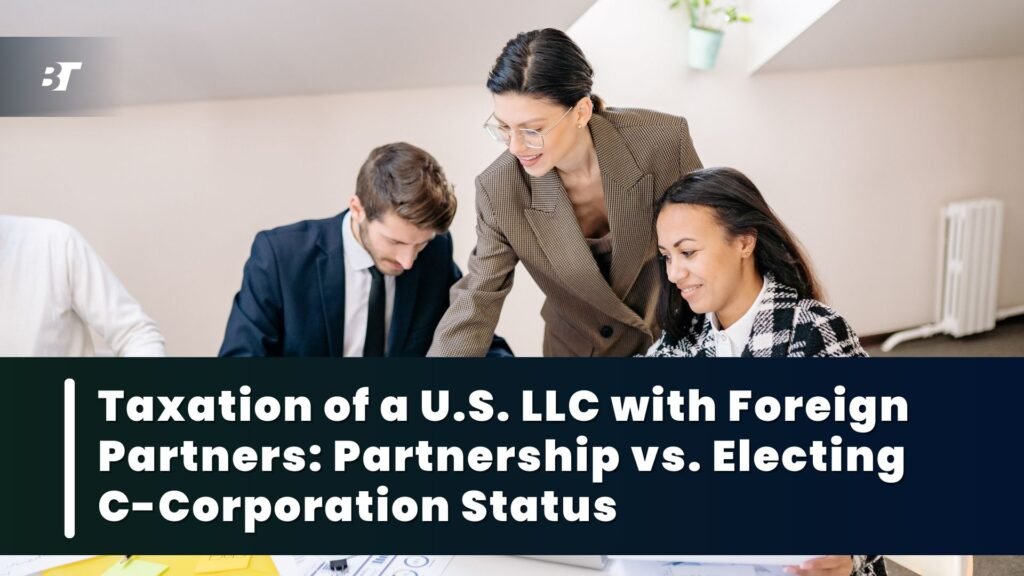
For international entrepreneurs, forming a U.S. Limited Liability Company (LLC) is a strategic move that offers a blend of operational flexibility and liability protection. However, once the entity is established, foreign partners face a critical decision: how the business should be taxed.
By default, an LLC with two or more members is treated as a partnership for U.S. tax purposes. However, the IRS allows these entities to elect to be taxed as a C-Corporation by filing Form 8832 (Entity Classification Election). For non-resident partners, this choice significantly impacts tax efficiency, withholding obligations, and individual compliance requirements.
When a multi-member LLC does not proactively elect corporate taxation, the IRS applies the default partnership rules. This is known as “pass-through” taxation.
Advantages:
Disadvantages:
An LLC can choose to be treated as a corporation by filing Form 8832. Once this election is effective, the IRS treats the LLC as a separate taxable entity.
Advantages:
Disadvantages:
Assume an LLC with two foreign partners generates $100,000 in annual profit.
Factor | Partnership Taxation | C-Corporation Election |
Tax Layers | Single Level | Double Level |
Entity Level Tax | $0 (Pass-through) | $21,000 (21% Corp Tax) |
Owner Tax/Withholding | Individual rates via 1040-NR | Up to 30% on $79,000 dividends |
Compliance Effort | Higher (Multiple Forms + ITINs) | Lower (Entity level only) |
Loss Utilization | Immediate for Partners | Trapped in Entity |
Foreign Owner Filing | Required | Usually Not Required |
Regardless of the tax election, foreign-owned U.S. LLCs face specific reporting mandates. One of the most critical is Form 5472 (Information Return of a 25% Foreign-Owned U.S. Corporation or Foreign-Owned U.S. Disregarded Entity).
Because the IRS closely monitors transactions between U.S. companies and their foreign owners, failing to file Form 5472 or maintaining improper transfer pricing documentation can lead to minimum penalties starting at $25,000. Furthermore, businesses must also consider state-level tax filings and franchise taxes, which vary depending on the state of incorporation.
Given these complexities, many entrepreneurs rely on professional assistance for Form 5472 filing and US Business Taxation to ensure they avoid costly errors.
The optimal structure depends on your business goals. If you expect initial losses or want to avoid double taxation, the Partnership model may be superior despite the higher filing burden. If you prefer to avoid the hassle of individual U.S. tax returns for every partner or plan to attract institutional investors, the C-Corporation election is often the preferred route.
Navigating U.S. tax laws from abroad requires precision. Led by Principal Consultant Kishore Chennu (MBA, CMA, EA), our team at TheTaxBooks specializes in U.S. Company Formation and ongoing tax compliance for international clients. Whether you need help with ITIN applications, Form 1065 preparation, or C-Corp tax planning, we provide the expertise to keep your U.S. venture on solid ground.
To learn more about how you can reduce your taxes and save money, check out the helpful resources on our blog or contact us today to schedule a consultation.