We Make Tax Filing A Breeze
Home » The Debt vs. Equity Trap: Funding Your US Corp Without IRS Red Flags

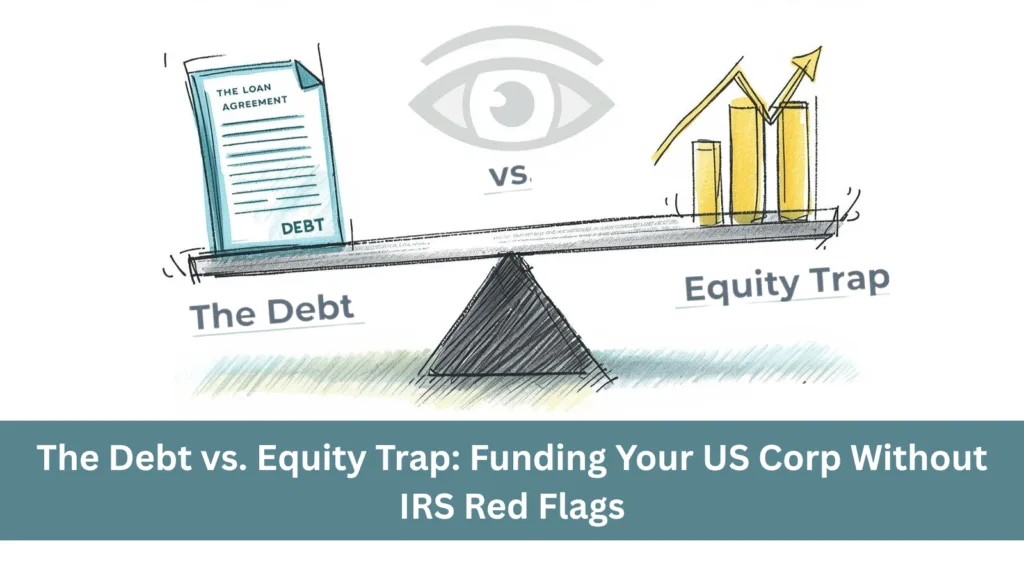
If you’re an international founder establishing a US corporation be it a C-Corp or S-Corp you’ve likely already made one critical, early decision: how to capitalize your venture. More often than not, the founder or the foreign parent entity provides the initial money.
It’s common practice to label this money transfer a “loan.” After all, you expect to be repaid, right?
But here’s a crucial warning from our years of experience in US tax planning: The IRS is highly suspicious of related-party loans, and for good reason.
This isn’t just about paperwork; it’s about the economic reality of the transaction. The IRS is laser-focused on whether your “loan” is a genuine debt or merely a disguised capital contribution (equity). Misjudging this distinction is one of the quickest ways to trigger an audit and land in a costly tax nightmare.
The IRS’s scrutiny boils down to one powerful, four-letter word: Deduction.
When you set up your initial funding as a true debt (a loan), the US corporation pays interest to the shareholder. That interest payment is a tax-deductible expense for the corporation, lowering its overall taxable income. It’s a smart, legal tax move.
However, if those funds are classified as equity (a capital contribution), the corporation gets zero tax deduction for any payments made to the shareholder.
Because the tax savings from an interest deduction can be significant, the IRS is naturally skeptical when the lender and borrower are related parties (like a corporation and its owner). They suspect the structure is only being used to siphon profits out of the corporation in a tax-advantaged way.
So, what’s the real danger? If the IRS successfully argues that your “loan” was actually a capital contribution, the financial consequences are severe and retroactive:
The takeaway? You must eliminate all doubt about the nature of the transaction from the moment the funds hit the bank account.
There is no simple formula, no 3:1 ratio that guarantees safety. Instead, the IRS—and subsequently, the courts—look at a set of factors, often referenced under Internal Revenue Code Section 385. They are essentially trying to answer one question: Would an unrelated commercial lender have agreed to the exact same terms?
To prove that your transaction is debt, you must have the legal and economic characteristics of a lender-borrower relationship. Focus on these absolutes:
If the transaction looks like money you’d give a startup you believe in, rather than a debt you expect back, the IRS will challenge it:
Our advice is always to seek compliance first and deductions second. Here is the framework we recommend for international businesses:
The complexity of the Debt vs. Equity rule, combined with strict international reporting requirements, is often too much for founders to manage while simultaneously launching a business.
At TheTaxBooks, led by our Principal Consultant, Kishore Chennu, EA-IRS (US), we specialize in demystifying these rules for businesses worldwide. We leverage our 15+ years of US tax experience to provide:
Don’t let a simple funding choice derail your US venture. Let us manage the tax complexity while you focus on growth.
To learn more about how you can reduce your taxes and save money, check out the helpful resources on our blog or contact us today to schedule a consultation.