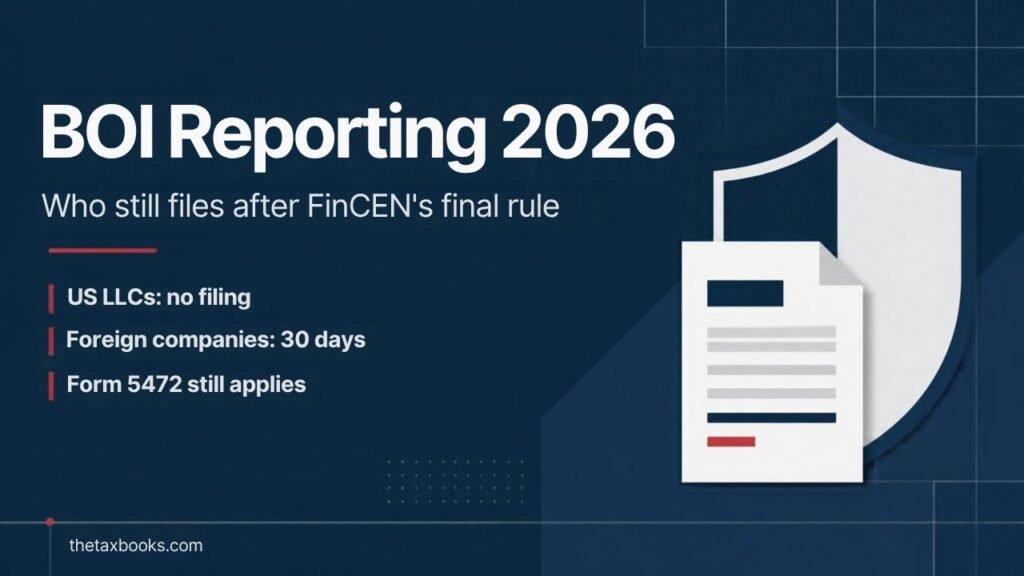
If your company was formed in the United States, you no longer file a beneficial ownership information (BOI) report with FinCEN. That includes the Delaware C-Corp or Wyoming LLC that many Indian founders set up. FinCEN made this permanent in a final rule published and effective on August 14, 2026.
The companies that still file are those formed under the law of another country that register to do business in a US state. If you run an Indian private limited company and register it directly in a US state, this rule still applies to you.
What changed, and when
The Corporate Transparency Act (CTA) originally required almost every US corporation and LLC to report its owners. That requirement was narrowed in steps.
| Date | What happened |
|---|---|
| January 1, 2024 | The original reporting rule took effect. Most US companies had to file. |
| March 2, 2025 | Treasury suspended enforcement against US citizens, domestic companies and their owners. |
| March 26, 2025 | FinCEN’s interim final rule removed all US-formed companies from the definition of “reporting company.” |
| August 14, 2026 | FinCEN’s final rule made those changes permanent and added two more exemptions for US persons. |
The final rule did three things beyond the interim rule. It confirmed the exemption for US companies. It stopped foreign companies from having to report US persons who helped register them. And it ended the requirement for US persons who hold a FinCEN ID to keep that information updated.
Who this applies to
US-formed companies. Any corporation, LLC or similar entity created by filing with a US secretary of state is exempt. You have no initial report to file, no updates and no corrections.
Foreign-formed companies registered in a US state. These are now the only “reporting companies.” An entity qualifies if it is formed under the law of a foreign country and has registered to do business in a US state or tribal jurisdiction by filing with a secretary of state or similar office.
US persons. A foreign reporting company does not report any US person, whether that person is a beneficial owner or a company applicant. A foreign company owned entirely by US persons still files a report, but lists no beneficial owners.
The rule for foreign reporting companies
If your company is a foreign reporting company, here is what applies.
What the company reports about itself:
- Its legal name and any trade or “doing business as” names
- Its US address, or the address from which it conducts US business
- Its foreign jurisdiction of formation
- The US state where it first registered
- Its IRS taxpayer identification number, such as an EIN. If it has none, a foreign tax ID and the country that issued it.
Who counts as a beneficial owner. An individual who exercises substantial control over the company, or who owns or controls at least 25% of its ownership interests. Only individuals count. A parent company is not itself a beneficial owner.
Company applicants. Up to two individuals: the person who filed the registration, and the person primarily responsible for directing that filing. US persons in this role are not reported.
Deadlines.
- Initial report: within 30 days of the earlier of two dates. Either the date the company receives actual notice that its US registration is effective, or the date the state first gives public notice of it.
- Updates and corrections: within 30 days of any change to the information already reported.
Exemptions still exist for certain types of entities. A foreign company should check them carefully before deciding it must file.
Where Indian founders fit
Most Indian founders now have no BOI obligation. The structure you chose decides it.
| Your structure | BOI report to FinCEN? | What still applies |
|---|---|---|
| A Delaware or Wyoming single-member LLC owned by you as an Indian resident | No. The LLC is a US company. | A pro forma Form 1120 with Form 5472 each year, if the LLC had reportable transactions with you |
| A Delaware C-Corp with Indian founders | No. The corporation is a US company. | Form 1120, plus Form 5472 if the corporation is 25% foreign-owned and had reportable related-party transactions |
| A US subsidiary owned by your Indian private limited company | No. The subsidiary is a US company. The Indian parent is not registered in any US state. | Form 1120 or pro forma 1120 with Form 5472, depending on how the subsidiary is classified |
| Your Indian private limited company itself, registered as a foreign corporation in a US state | Yes, unless an exemption applies. File within 30 days of registration. | Report the non-US individuals who own 25% or more or exercise substantial control |
The last row is the one to watch. Some Indian companies register directly in a state such as Texas or California to sign contracts or hire locally. That registration starts the 30-day BOI clock.
What you actually have to file
| Filing | Who files | Where |
|---|---|---|
| BOI report | Foreign reporting companies only | FinCEN BOI E-Filing |
| FinCEN ID updates | Non-US individuals who hold a FinCEN ID, within 30 calendar days of a change | FinCEN |
| Form 5472 with pro forma Form 1120 | Foreign-owned US disregarded entities, including single-member LLCs owned by a non-US person | IRS, by fax or mail to the dedicated Ogden address. It cannot be e-filed. |
| Form 5472 attached to Form 1120 | 25% foreign-owned US corporations with reportable transactions | IRS, with the corporate return |
The full rule is in the Federal Register. FinCEN also published questions and answers on the final rule.
Penalties for getting it wrong
BOI. For a foreign reporting company, the civil penalty for a reporting violation is up to $606 per day while the violation continues. FinCEN says it will base enforcement on willful violations, not inadvertent mistakes or a lack of awareness. Criminal penalties may also apply to willful violations.
Form 5472. For most Indian founders, this is the bigger risk. The IRS assesses a $25,000 penalty for each failure to file Form 5472 on time. It applies the same penalty for failing to keep the required records. If the failure continues more than 90 days after the IRS notifies you, a further $25,000 applies for each 30-day period. A substantially incomplete form counts as a failure to file. See the IRS instructions for Form 5472.
Common mistakes
Assuming no BOI means no federal filing. The BOI exemption is a FinCEN rule. It does not change any IRS requirement. A foreign-owned single-member LLC still files a pro forma Form 1120 with Form 5472 for each year it has reportable transactions. Forming the LLC and putting money into it count as reportable transactions. We cover the details in our Form 5472 filing service and in our Form 5472 guide.
Filing a BOI report you do not need. US companies have no obligation to file. FinCEN plans a one-time deletion of information it believes came from US persons. It has said it does not expect to delete US-person information in filings made after February 10, 2027. It will not send you a confirmation of deletion.
Treating your bank’s questions as a FinCEN filing. Banks still collect beneficial ownership details when you open a business account. That comes from FinCEN’s Customer Due Diligence Rule, which the final rule did not change. Answer your bank. It is not a BOI report. Our guide on opening a US business bank account as a non-resident explains what banks ask for.
Forgetting state rules. New York’s LLC Transparency Act took effect on January 1, 2026. Because it borrows the federal definitions, it currently applies only to LLCs formed under foreign law that are authorized to do business in New York. Those formed before January 1, 2026 must file by January 1, 2027.
Registering an Indian company in a US state without a plan. Registration starts a 30-day BOI deadline. Decide before you register whether a US subsidiary would serve you better. A subsidiary avoids BOI but brings its own IRS filings.
Leaving a non-US FinCEN ID out of date. US persons no longer need to update a FinCEN ID. Non-US individuals still must report any change within 30 calendar days.
Frequently asked questions
Do I need to file a BOI report for my US LLC in 2026?
No. Any LLC or corporation formed by filing with a US secretary of state is exempt from BOI reporting. This applies whether the owners live in the US or in India.
I filed a BOI report in 2024. What happens to that information?
FinCEN plans to delete information it reasonably believes was provided by US persons, such as filings that used a US passport or US driver’s license. It will not confirm the deletion to you. It will post a notice on its website when the process is complete.
My Indian company owns a US subsidiary. Does either of them file a BOI report?
Usually not. The US subsidiary is a US company, so it is exempt. The Indian parent is not a reporting company unless it has itself registered to do business in a US state. The subsidiary may still have IRS filings, including Form 5472.
Why is my US bank still asking for beneficial ownership information?
Banks must collect it from business customers under FinCEN’s Customer Due Diligence Rule. The final rule did not change that requirement.
BOI reporting is now a narrow obligation, but the IRS filings that sit alongside it have not changed. If you are not sure which rules apply to your structure, or you have missed a Form 5472 for an earlier year, we can review your situation. Get in touch.
This article is for general information only and reflects US tax rules as of October 2026. It is not tax, legal or accounting advice, and it does not create a client relationship. Tax rules change and outcomes depend on your specific facts. Speak with a qualified tax professional before acting.