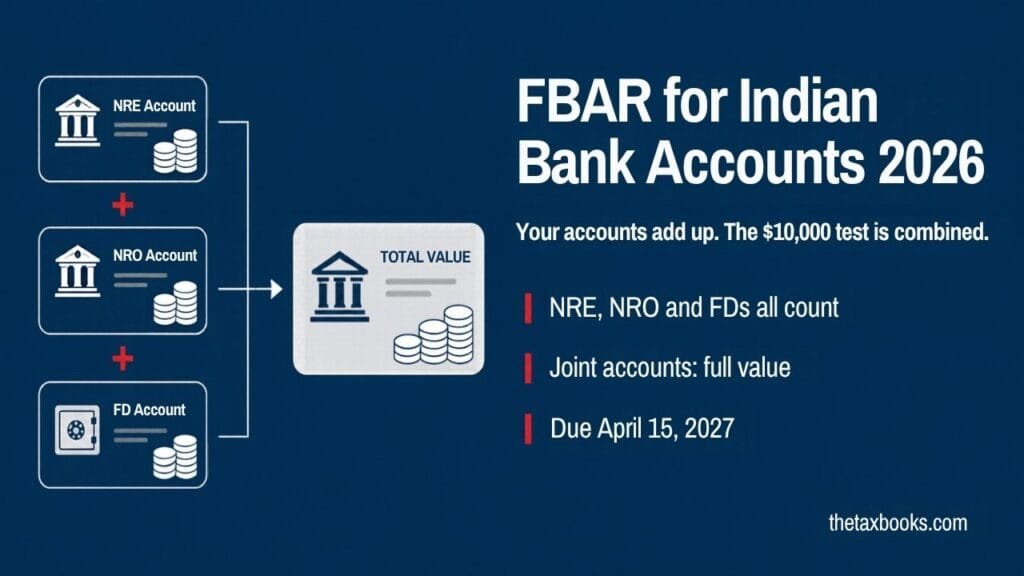
If you are a US person and your Indian accounts together held more than $10,000 at any point in the year, you must file an FBAR (FinCEN Form 114). The test is the combined total of all your foreign accounts, so three small accounts can trigger it. For the 2026 calendar year, the FBAR is due April 15, 2027, with an automatic extension to October 15, 2027.
Many Indian professionals in the US miss this. They check each account on its own, forget an old salary account, or leave out a joint account with their parents. This guide covers who files, which Indian accounts count, how to do the math, and what to do if you missed earlier years.
Who this applies to
The FBAR applies to every US person. For individuals, that means:
- US citizens, wherever they live.
- Green card holders.
- Anyone who is a US tax resident under the substantial presence test. Many H-1B and L-1 holders meet this test in their first full year in the US. Our guide to the substantial presence test explains how the day count works.
A tax treaty does not change this. The IRS states that tax treaties do not affect FBAR filing obligations, so the India–US treaty will not take you out of FBAR if you are a US resident.
Dual-status filers, such as people in their first year on an H-1B, must file an FBAR. F-1 and J-1 holders who are “exempt individuals” under the substantial presence test do not need to file one.
If you are a non-resident alien for the whole year, the FBAR does not apply to you.
How the $10,000 rule works
Four points decide whether you file:
- It is the combined total. Add up the highest balance of every foreign account you own or control. If the total is more than $10,000, you file and you report every account, including the small ones.
- It is the highest balance, at any time. A single day above the threshold counts. A year-end balance of ₹50,000 does not help if the account held ₹10 lakh in June.
- Income does not matter. An account that earned nothing, or sat dormant, still counts.
- Convert at the year-end Treasury rate. Find each account’s maximum value in rupees, then convert it to US dollars using the Treasury Reporting Rate of Exchange for December 31 of that year. Statements issued at least quarterly can be used to find the maximum, if they fairly reflect it.
Example
Priya is on an H-1B in Texas and is a US tax resident for 2026. She has three accounts in India. Their highest balances during 2026 were:
| Account | Highest balance in 2026 | In US dollars* |
|---|---|---|
| NRE savings account | ₹4,50,000 | $5,000 |
| NRO savings account | ₹2,70,000 | $3,000 |
| Fixed deposit | ₹2,25,000 | $2,500 |
| Combined total | $10,500 |
*Uses an illustrative rate of ₹90 = $1 for round numbers. On your filing, use the Treasury rate for December 31, 2026.
No single account crossed $10,000. The combined total did, so Priya must file an FBAR and report all three accounts.
Which Indian accounts count
The FBAR covers financial accounts held at institutions located outside the US. For Indian accounts, that means:
| Account type | Reportable on FBAR? |
|---|---|
| Savings and current accounts | Yes |
| NRE, NRO and FCNR(B) deposits | Yes |
| Fixed and recurring deposits | Yes |
| Demat and broking accounts | Yes. Report the account; you do not list each share separately. |
| Indian mutual fund holdings | Yes |
| Life insurance or annuity policies with a cash or surrender value (for example, some LIC endowment policies) | Yes |
| Joint accounts with parents or siblings | Yes, at the full account value |
| Your parents’ accounts where you hold signature authority or a power of attorney | Yes, even if you have never used it |
| PPF, EPF and NPS | Yes |
| Property, gold or cash you hold directly | No |
| An account at a US branch of an Indian bank | No. Location decides, so a US branch is not a foreign account. |
Joint accounts are the most common miss. If your name is on your parents’ account in India, each US person on that account must report the entire balance. Your share does not matter.
What you actually have to file
The FBAR is one of up to three items that cover foreign accounts. They have different thresholds and go to different places.
| Item | What it covers | Threshold | Where it goes |
|---|---|---|---|
| FinCEN Form 114 (FBAR) | Foreign financial accounts | More than $10,000 combined, at any time in the year | Filed online with FinCEN through the BSA E-Filing System. Not attached to your tax return. |
| Form 8938, Statement of Specified Foreign Financial Assets | Foreign financial accounts plus certain other foreign assets | Living in the US: more than $50,000 on December 31 or $75,000 at any time (single); more than $100,000 on December 31 or $150,000 at any time (married filing jointly) | Attached to your Form 1040 |
| Form 1040, Schedule B, Part III | Yes/no questions about foreign accounts | Questions 7a and 7b | Part of your Form 1040 |
Filing Form 8938 does not replace the FBAR. If you meet both thresholds, you file both. We handle both through our FBAR and FATCA reporting service, alongside your federal and state tax return.
Deadlines for the 2026 calendar year
- April 15, 2027: FBAR due for calendar year 2026.
- October 15, 2027: automatic extended deadline. You do not need to request it.
- Records: keep account statements or a copy of the filed FBAR for five years from the due date. For each account, the records should show the name on the account, the account number, the bank’s name and address, the account type, and the maximum value during the year.
Penalties for getting it wrong
The FBAR has some of the steepest penalties in US tax compliance. The maximum civil penalties for penalties assessed on or after January 17, 2025 are:
| Violation | Maximum civil penalty |
|---|---|
| Non-willful (you did not know, or made a mistake) | Up to $16,536 |
| Willful | Up to $165,353 or 50% of the account balance at the time of the violation, whichever is greater |
These amounts are adjusted for inflation. In Bittner v. United States (2023), the Supreme Court held that the non-willful penalty applies once per report, not once per account. Willful violations can also lead to criminal penalties.
There is no minimum penalty. The IRS says that if you file a late FBAR that correctly reports the accounts, and it finds the violation was due to reasonable cause, no penalty is imposed.
If you missed FBARs in earlier years
Filing late is still far better than not filing. The IRS advises people who have not been contacted about a late FBAR, and who are not under examination or investigation, to file the late FBARs as soon as possible.
- File through the BSA E-Filing System, choose the calendar year you are reporting, and explain why the filing is late. The explanation box allows up to 750 characters.
- If you also left income off your tax returns, such as interest on an NRO deposit, a late FBAR alone is not enough. The IRS Streamlined Filing Compliance Procedures may apply if your conduct was non-willful.
Common mistakes
- Checking each account on its own. The threshold is the combined total of all foreign accounts.
- Using the year-end balance. You need each account’s highest balance during the year.
- Forgetting old accounts. A dormant salary account from your first job in India still counts if it is open.
- Leaving out joint accounts with parents. Report the full balance, not your share.
- Ignoring signature authority. A power of attorney over a parent’s account can make it reportable, even if you never used it.
- Assuming “tax-free in India” means “not reportable”. NRE interest may be exempt in India. The account is still reportable on the FBAR.
- Filing the FBAR with your tax return. It goes to FinCEN separately, through the BSA E-Filing System.
Frequently asked questions
Do I need to file an FBAR if each of my Indian accounts is under $10,000?
Yes, if the combined highest balances of all your foreign accounts exceeded $10,000 at any time during the year. You then report every account.
My parents added me as a joint holder on their account. Do I have to report it?
Yes. Each US person on a joint account reports the entire balance of that account.
Is the FBAR filed with my tax return?
No. The FBAR is filed online with FinCEN through the BSA E-Filing System. Your Form 1040 asks about foreign accounts on Schedule B, and Form 8938 is a separate form that is attached to your return.
Which exchange rate do I use?
Use the Treasury Reporting Rates of Exchange for the last day of the calendar year. For 2026 accounts, that is the rate for December 31, 2026.
I am on an H-1B. Do I need to file?
If you are a US tax resident under the substantial presence test, you are a US person for FBAR purposes, and the $10,000 rule applies to you.
If your Indian accounts crossed $10,000 this year, or you think you missed earlier years, we can review your accounts and prepare your FBAR and Form 8938. Get in touch.
This article is for general information only and reflects US tax rules as of October 2026. It is not tax, legal or accounting advice, and it does not create a client relationship. Tax rules change and outcomes depend on your specific facts. Speak with a qualified tax professional before acting.