We Make Tax Filing A Breeze
Home » Global Tax Showdown: The US ‘Revenge Tax’ Threat, OECD Delays, & G7 Deal

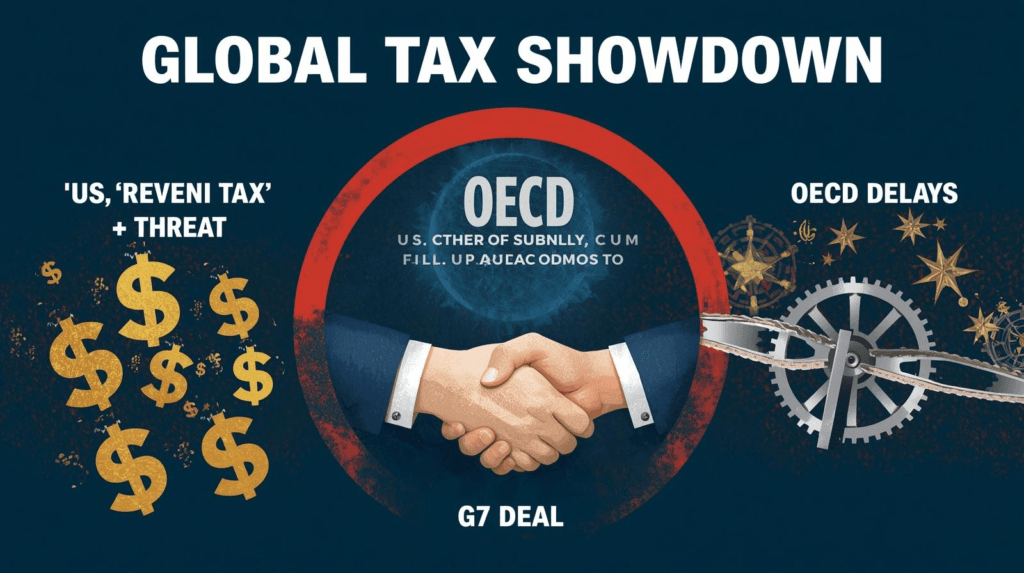
The world of international taxation is constantly shifting, but few legislative proposals have created as much geopolitical tension as the recently proposed (and subsequently removed) US ‘Revenge Tax,’ formally known as Internal Revenue Code Section 899.
For international businesses, especially those planning US expansion or currently operating an LLC or C-Corp in the States, these tax policy debates are more than just political theater—they represent genuine financial risk. They underscore the critical need for expert guidance in US tax filing and US company formation.
At TheTaxBooks, led by Principal Consultant Kishore Chennu (MBA, CMA, EA-IRS (US)), we specialize in translating these complex global tax movements into clear, actionable advice for our international clientele. Here is a deep dive into the ‘Revenge Tax,’ its connection to the OECD’s global tax deal, and why the threat of its revival remains relevant today.
The controversy surrounding the ‘Revenge Tax’ is directly linked to a massive global effort to reform corporate taxation: the OECD/G20 Inclusive Framework on Base Erosion and Profit Shifting (BEPS) 2.0, specifically its Pillar Two.
For years, multinational enterprises (MNEs) have been able to shift profits to low-tax jurisdictions. Pillar Two is designed to stop this.
Pillar Two is built around the Global Anti-Base Erosion (GloBE) Rules, which aim to ensure MNEs with annual revenues over €750 million (approx. $825 million) pay a minimum effective tax rate of 15% on their profits in every jurisdiction where they operate. The two main mechanisms are:
The US has not yet adopted the full GloBE Rules, which created an opening for other countries to potentially tax US MNEs under the UTPR—a situation the US government sought to avoid.
The ‘Revenge Tax’ (Section 899) was a legislative provision proposed within the US tax bill known as the “One Big Beautiful Bill Act” (OBBBA). It was explicitly designed as a retaliatory measure intended to pressure foreign countries into not applying the OECD’s new minimum tax rules (like the UTPR or Digital Services Taxes) to US companies.
Had it been enacted, Section 899 would have significantly increased US tax burdens on income earned by certain foreign individuals and entities from “discriminatory foreign countries.”
The primary targets were:
The core mechanism was an escalating additional tax rate (proposed to be 5% annually, potentially capped at 15% or 20%) on U.S.-source investment income like dividends, interest, and royalties.
The penalty would have been triggered if a country was deemed to impose “unfair foreign taxes” on American companies. This definition primarily targeted:
In mid-2025, the US government and its Group of Seven (G7) allies reached an understanding that led to the removal of Section 899 from the final US tax bill. This agreement effectively served as a temporary truce in the global tax war.
The G7 compromise centered on a commitment by the G7 nations to exempt US multinationals from key parts of the OECD’s Pillar Two rules, particularly the UTPR, by implementing a “side-by-side” approach. This special treatment would effectively:
In exchange for this commitment, the US dropped the highly controversial ‘Revenge Tax.’
The G7 deal was a political agreement, but its implementation depends on the slow, technical process of the OECD’s working groups. Delays and objections have put the agreement under severe stress.
Despite the G7 understanding, the technical negotiations for granting specific US exemptions under Pillar Two have stalled. Several countries have voiced strong criticism that a “side-by-side” system would:
Because a final, technical consensus at the OECD is proving elusive, the stability of the G7 deal is in question.
US lawmakers have indicated support for reviving Section 899 if the OECD fails to finalize the agreed-upon Pillar Two exemptions by upcoming deadlines.
In short, the threat of the ‘Revenge Tax’ being enacted is directly proportional to the lack of progress on the OECD’s global tax framework.
For foreign entrepreneurs and global companies, especially those based in regions like India and looking to establish a US presence (LLC, C-Corp, etc.), this policy uncertainty highlights a crucial reality: US international tax law is volatile and unforgiving of mistakes.
Successfully incorporating and operating a business in the US requires proactive planning to mitigate risks arising from global tax disputes. For our clients, we focus on stable, compliant structures that protect their interests regardless of the political climate.
This is where TheTaxBooks’ specialized expertise becomes invaluable. We provide end-to-end services from US Company Formation (LLC, C-Corp) and US bank account opening assistance to specialized tax compliance like Form 5471 Filing, Form 5472 Filing, and comprehensive US Business Taxation and Bookkeeping & Accounting services.
Navigating the cross-border tax issues requires a professional who understands both US federal and international obligations. It’s not a time for guesswork.
To learn more about how you can reduce your taxes and save money, check out the helpful resources on our blog or contact us today to schedule a consultation.