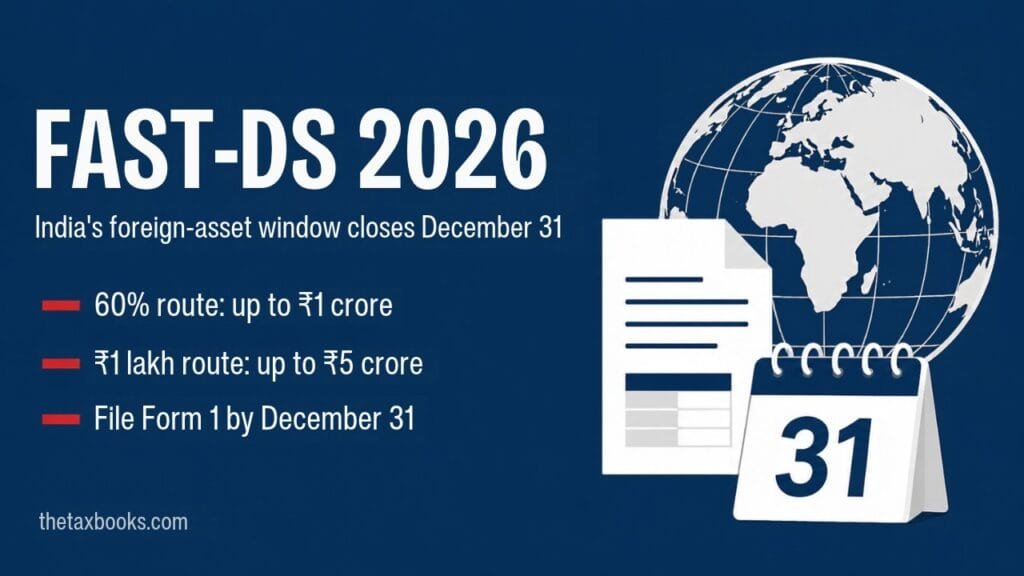
India’s one-time foreign-asset disclosure window, FAST-DS, closes on December 31, 2026. It lets you declare foreign assets or foreign income that you left out of your Indian tax returns, and settle it at a fixed price. You pay an effective 60% if the money was never taxed, or a flat ₹1 lakh fee if only the reporting was missed. In return, you get immunity from further tax, penalty and prosecution under the Black Money Act for what you declare.
If you came back from the US with a bank account, a brokerage account, RSUs or a 401(k) that never made it into Schedule FA, this is likely the cheapest fix you will get.
What FAST-DS is
FAST-DS is the Foreign Assets of Small Taxpayers Disclosure Scheme, 2026. It sits in Chapter IV (sections 130 to 144) of the Finance Act, 2026. The CBDT notified its rules on August 14, 2026, through Notification No. 114/2026.
| Item | Detail |
|---|---|
| Window opened | August 16, 2026 |
| Last date to file Form 1 | December 31, 2026 |
| Valuation date | March 31, 2026 |
| How to file | Online, on the Income Tax e-filing portal |
The Income Tax Department’s FAST-DS FAQs state that no declaration can be filed after December 31, 2026. No extension has been announced.
Who this applies to
You can make a declaration if either of these is true:
- You were resident in India in the relevant year.
- You are a non-resident or RNOR now, but you were resident in India in the year you earned the income or bought the asset.
Being an NRI today does not rule you out. What counts is your residential status in the year the income arose or the asset was acquired.
The scheme is built for situations like these:
- You moved back from the US, kept your US bank or brokerage account, and did not list it in Schedule FA once you became resident.
- You work in India for a US-headquartered company and hold RSU or ESPP shares in a US brokerage account that you missed in Schedule FA.
- You earned dividends or interest on those accounts and never offered that income to tax in India.
A declaration can be made on three grounds. You did not file a return. You filed a return but left the asset or income out. Or the income escaped assessment.
Why you may have received an email. Since late September 2026, the Income Tax Department has been emailing taxpayers it believes hold overseas financial interests. The email points to the Foreign Assets Information section of your Annual Information Statement (AIS) and to FAST-DS. It is an advisory, not a legal notice. Log in to the e-filing portal directly to check your AIS, rather than clicking links in the email.
Check first: you may not need FAST-DS
Start by matching what the department holds in your AIS against your past returns.
If the asset was in Schedule FA every year and the income was taxed, there is nothing to declare.
If your foreign holdings are small, look at the ₹20 lakh rule. From October 1, 2024, the ₹10 lakh Black Money Act penalty for not reporting a foreign asset does not apply when the total value of your foreign assets, other than immovable property, does not exceed ₹20 lakh. The Finance Act, 2026 extends the same threshold to prosecution, with retrospective effect from October 1, 2024.
Two limits apply. Foreign property is outside this relief whatever its value. And the threshold only removes the penalty and prosecution: the asset still belongs in Schedule FA, and any foreign income is still taxable. If your only foreign holding is a small account, get advice before paying anything under the scheme.
The two routes and what they cost
FAST-DS has two routes, with different ceilings and very different prices.
| Category 1 | Category 2 | |
|---|---|---|
| What it covers | A foreign asset whose source you cannot explain, or foreign income never offered to tax in India | A foreign asset bought from income already taxed in India, or bought while you were non-resident, that was left out of the relevant schedule of your return |
| Ceiling | ₹1 crore (asset value on March 31, 2026 plus undisclosed income, combined) | ₹5 crore (total value of the assets) |
| Amount payable | 30% tax plus an equal additional amount: effectively 60% | Flat fee of ₹1 lakh |
The official example. An undisclosed foreign bank account valued at ₹60 lakh, plus ₹20 lakh of undisclosed foreign income, adds up to ₹80 lakh. That is within the ₹1 crore ceiling. The tax is ₹24 lakh, the additional amount is another ₹24 lakh, and the total payable is ₹48 lakh.
The ceilings are cliffs. If your Category 2 assets total ₹6.5 crore, the department’s FAQs say you cannot use the scheme at all. There is no higher rate for the excess.
The category follows your facts. You cannot simply choose the ₹1 lakh route. You need to show where the money came from, with past returns, Form 16s, salary records or bank trails. Assets bought while you were a non-resident, from income earned abroad, generally fit Category 2.
RSUs from a US employer are reported as a foreign shareholding. Shares that were taxed in India as salary when they vested have an explained source. Dividends on those shares that were never offered to tax count as undisclosed foreign income.
How your assets are valued
Every asset is valued as of March 31, 2026. As a general rule, the value is the higher of what you paid and what the asset would sell for on that date. If no market valuation is done, the indexed cost of acquisition is used.
- Listed shares, including US RSU and ESPP shares: the higher of your cost and the average of the day’s highest and lowest price on March 31, 2026. If there was no trading that day, the nearest earlier trading day is used.
- Bank accounts: the sum of every deposit since the account was opened, not the balance. Deposits made from withdrawals out of the same account are excluded, so money moved out and back in is not counted twice.
- Foreign property: the higher of cost and market price, backed by a valuation report from a valuer recognised in the country where the property is. Without a report, the indexed cost is used.
- Currency: values are converted into rupees at the RBI reference rate on March 31, 2026.
The bank-account rule surprises most people. A US checking account with a small balance today, but ten years of salary credits, can carry a value far above anything you would expect. Pull the full statement history before assuming you are under a ceiling.
For assets other than bank accounts, a difference of up to 20% between your declared value and the value later determined by the department does not, on its own, make the declaration invalid. Bank accounts get no such margin.
US retirement accounts, such as a 401(k) or an IRA, are foreign assets you need to report. There is no income to report on them while the money stays in the account.
What you actually have to file
FAST-DS is a four-form process. The matter closes only when you receive Form 4.
| Step | Form | Who | Deadline |
|---|---|---|---|
| Declaration, with documents and valuation reports | Form 1 | You | By December 31, 2026 |
| Order stating the amount payable | Form 2 | Department | Within one month from the end of the month you file Form 1 |
| Payment | Challan ITNS 289 | You | Within two months from the end of the month you receive Form 2 |
| Late payment | Challan ITNS 289 | You | A further two months, with simple interest of 1% per month or part of a month |
| Intimation of payment, with proof | Form 3 | You | Within the payment period |
| Certificate confirming the declaration | Form 4 | Department | Within one month from the end of the month you file Form 3 |
December 31 is the deadline for declaring, not for paying. If you file Form 1 in December 2026, Form 2 should arrive by the end of January 2027. You would then have until the end of March 2027 to pay without interest, and until the end of May 2027 with interest. Miss that outer limit and you lose the benefit of the scheme.
Form 1 needs documents proving how you acquired each asset or earned the income, plus a valuation report where one applies. You can declare several assets, and several types of asset or income, in one Form 1. The e-filing portal’s FAQs on Form 1 cover the filing steps.
What you get, and what you give up
What you get:
- Immunity from any further tax, penalty and prosecution under the Black Money Act for the income or asset you declare.
- The declared income, or the investment in the declared asset, is not added to your total income under the Income-tax Act or the Black Money Act.
- If an assessment covering that asset or income is already pending, the Assessing Officer must take your declaration into account.
What you give up:
- You cannot seek rectification, revision or relief on any assessment already made for the declared income or asset.
- Amounts paid under the scheme are not refundable.
- If any material detail in your declaration turns out to be false, the declaration becomes void.
Who cannot use it: income or assets linked to proceeds of crime where proceedings have begun under the Prevention of Money-laundering Act, 2002, and any year for which a Black Money Act assessment has already been completed.
FAST-DS deals with tax under the Black Money Act. It does not settle other matters, such as foreign exchange rules.
Penalties for getting it wrong
Outside the scheme, the Black Money Act charges 30% tax on undisclosed foreign income or assets. On top of that, it allows a penalty of three times the tax, which takes the total to as much as 120% of the value. Not reporting a foreign asset in your return can also attract a ₹10 lakh penalty for each default, subject to the ₹20 lakh threshold above. Prosecution is possible too.
The department already holds data on foreign accounts linked to PANs. After December 31, 2026, that data can be used in regular proceedings, at those rates, instead of the 60% or ₹1 lakh the scheme offers.
What FAST-DS does not change on the US side
FAST-DS settles your position in India only. It does not touch your US filings.
If you are still a US person (a US citizen, or a green card holder who has not formally given up the green card), you keep filing in the US after moving to India:
- Form 1040 reporting your worldwide income.
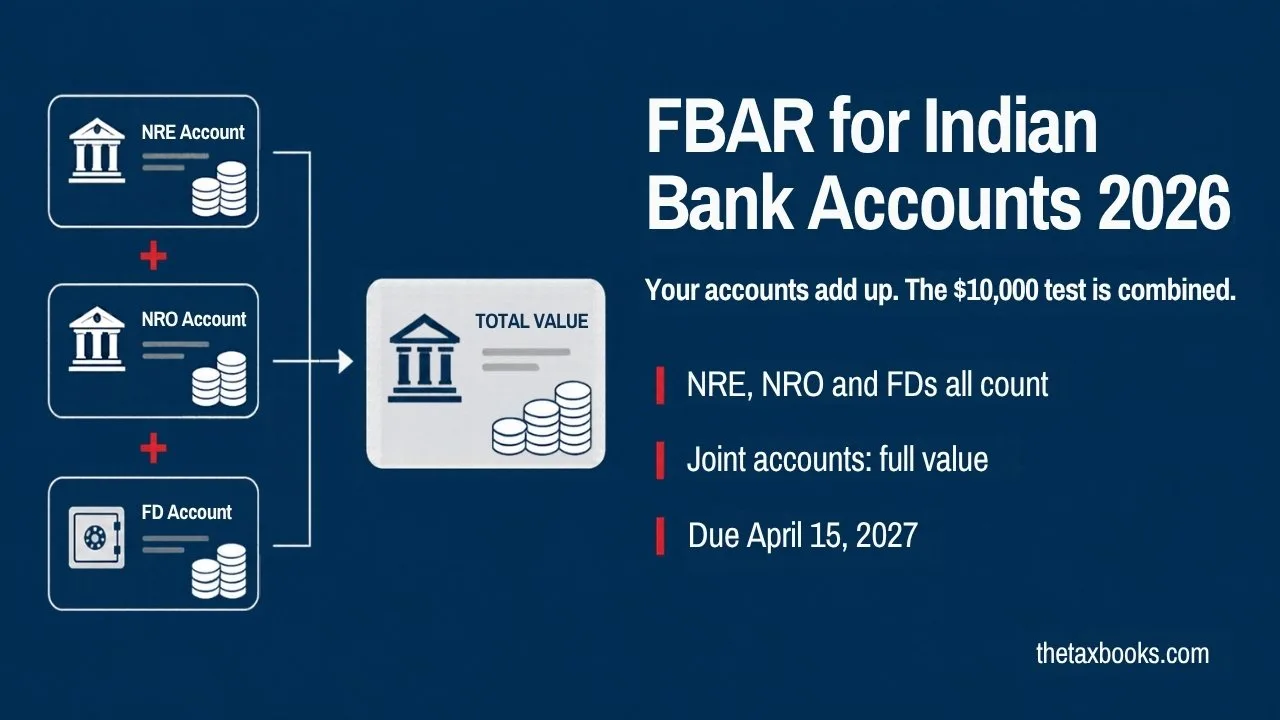
- FBAR, if your Indian accounts together exceed $10,000 at any point in the year. Our guide to FBAR rules for Indian bank accounts covers this in detail.
- Form 8938, if you are single and living abroad, and your specified foreign financial assets exceed $200,000 on the last day of the year or $300,000 at any time. For married couples filing jointly, the figures are $400,000 and $600,000. See the IRS page Do I need to file Form 8938?
Amounts you pay under FAST-DS cannot be claimed on your US tax return. And clearing up your Indian reporting does not fix any missed US forms, or the other way round. Each country needs its own fix.
If you are no longer a US person, your US bank, brokerage and retirement accounts are exactly what India treats as foreign assets. They belong in Schedule FA every year from the year you become resident, and their income may be taxable in India. Our guide to cross-border RSU taxation explains how vesting across a move is taxed in each country.
Common mistakes
- Valuing a bank account at its balance. The scheme counts every deposit since the account was opened.
- Assuming NRIs cannot use the scheme. Your status in the year you earned the income or bought the asset is what matters.
- Claiming the ₹1 lakh route without proof. Category 2 depends on showing the source of funds. Without documents, you may be in Category 1.
- Starting in late December. Overseas banks can take weeks to send old statements, and valuation reports take time. Aim to file Form 1 by mid-December.
- Clicking links in emails. Type the e-filing portal address yourself and navigate from there.
- Treating FAST-DS as a US fix. If you are a US person, your FBAR and FATCA reporting is a separate obligation.
Frequently asked questions
I’m an NRI now. Can I still use FAST-DS?
Yes, if you were resident in India in the year you earned the undisclosed income or acquired the undisclosed asset.
My US bank account has a small balance. Why is its value so high?
For the scheme, a bank account is valued at the total of all deposits made since it was opened, not at its balance. Deposits that came from withdrawals out of the same account are excluded.
Do I have to pay by December 31, 2026?
No. December 31, 2026 is the last date to file Form 1. You pay after the department issues its Form 2 order, within two months from the end of the month you receive it, or within a further two months with 1% monthly interest.
Can I claim the FAST-DS payment on my US tax return?
No. Amounts paid under FAST-DS cannot be claimed on a US tax return.
Is the department’s email a notice?
No. The email says it is an advisory, not a legal notice. It is still worth checking your AIS and past returns, since the department already holds the underlying data.
FAST-DS offers a fixed price, a fixed deadline and immunity under the Black Money Act. The work lies in getting the category, the valuation and your residential status right, because a declaration with false details can be void after you have paid. TheTaxBooks helps eligible taxpayers prepare and file Form 1, and we can review your US filings at the same time. Get in touch.
This article is for general information only and reflects Indian and US tax rules as of November 2026. It is not tax, legal or accounting advice, and it does not create a client relationship. Tax rules change and outcomes depend on your specific facts. Speak with a qualified tax professional before acting.