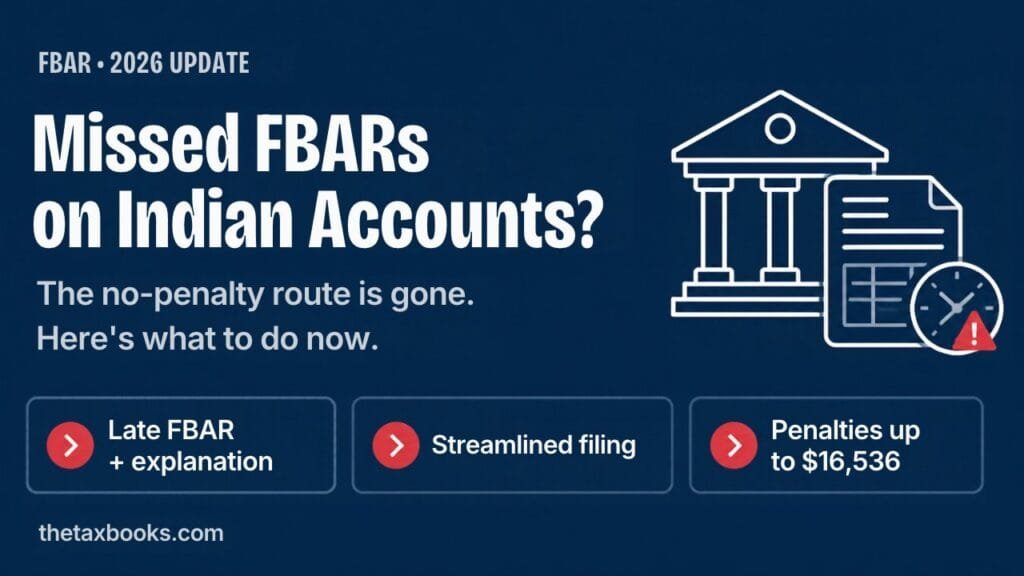
If you are a US person and forgot to file FBARs for your Indian bank accounts, you can still fix it. What changed is the safety net. On July 1, 2026, the IRS removed its Delinquent FBAR Submission Procedures, the page that promised no penalty for late FBARs if all your income had been reported. Your two main options now are filing the late FBARs with a reasonable-cause explanation, or using the Streamlined Filing Compliance Procedures. Which one fits depends on one question: did you also leave Indian income off your US tax returns?
What changed in July 2026
From 2014 until mid-2026, the IRS published a simple route for people whose only mistake was a missed FBAR. If you had reported all your income and paid the tax, you filed the late FBARs with an explanation, and the IRS said it would not impose a penalty.
That page was taken down on July 1, 2026, with no announcement. The IRS’s main FBAR page, last updated July 30, 2026, now says only that a late FBAR “is a violation and may subject you to penalties,” and that you should file late FBARs as soon as possible to keep potential penalties to a minimum.
Two things did not change:
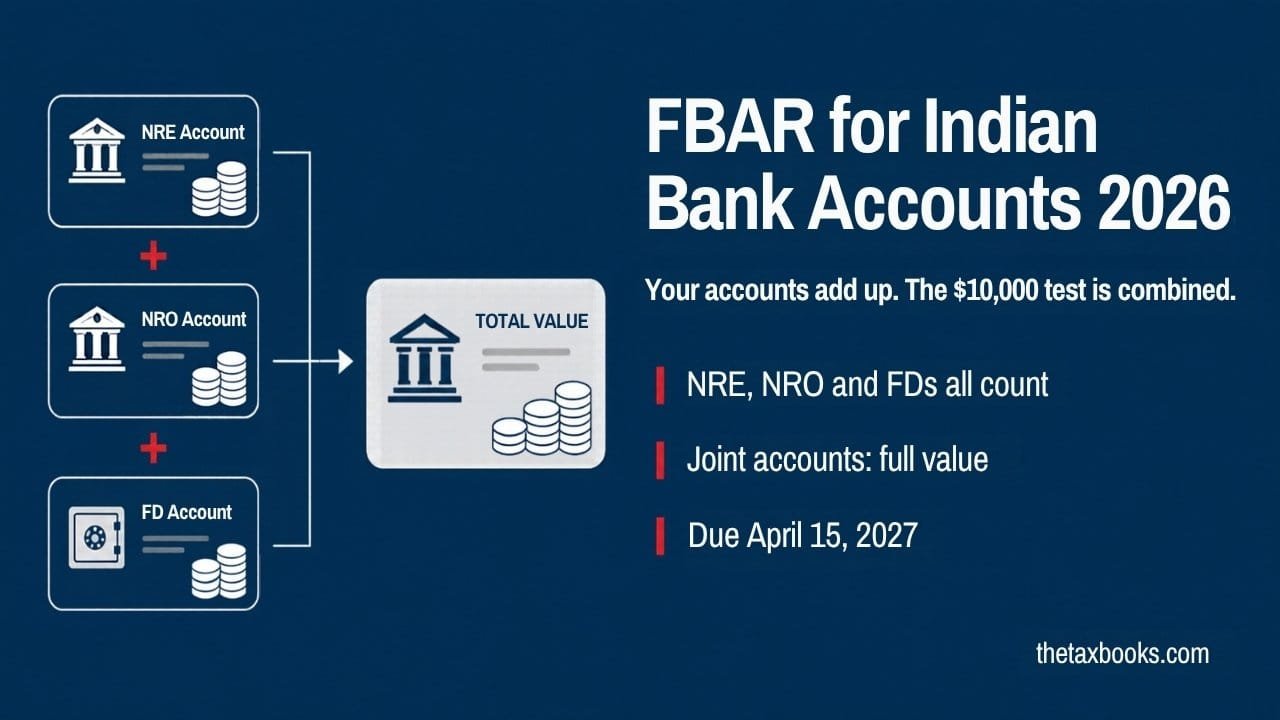
- The FBAR rules themselves. If your Indian accounts added up to more than $10,000 at any point in a calendar year, you still had to file.
- The law’s reasonable-cause exception. Under 31 U.S.C. 5321(a)(5)(B)(ii), no non-willful penalty is imposed if the violation was due to reasonable cause and the account balance was properly reported. The difference is that there is no longer a published IRS promise to rely on. Whether your reason counts is now decided case by case.
Who this applies to
You are in the right place if you were a US person in any of the last six years and had Indian accounts you did not report. A US person includes:
- US citizens, including those living in India
- Green card holders
- H-1B, L-1 and other visa holders who met the substantial presence test for that year
- Returning NRIs who were US tax residents in the years they missed, even if they are no longer residents today
The accounts that count are the ones covered in our guide to FBAR for Indian bank accounts: savings and current accounts, NRE, NRO and FCNR(B) deposits, fixed deposits, demat accounts, mutual funds, PPF, EPF and NPS, and accounts where you hold signature authority, such as a parent’s account.
First, work out which situation you are in
| Your situation | Likely route |
|---|---|
| You reported all Indian income (interest, dividends, gains) on your US returns. You only missed the FBARs. | File the late FBARs with a reasonable-cause explanation (Route 1) |
| You also left some Indian income off your US returns, such as NRE or FD interest, and the mistake was not deliberate. | Streamlined Filing Compliance Procedures (Route 2) |
| You knew you had to report and chose not to. | Speak to a tax professional before filing anything. The IRS points willful cases to its Criminal Investigation Voluntary Disclosure Practice. |
The second row is the common one for Indian clients. Many people believe NRE interest is “tax-free,” which it is in India. A US tax resident still has to report it on the US return.
Route 1: File the late FBARs on their own
This route fits if your tax returns were complete and only the FBARs are missing.
- Gather year-end and maximum balances for every Indian account, for each missing year.
- File each missing FBAR (FinCEN Form 114) electronically through the FinCEN BSA E-Filing System.
- Select the calendar year, and give the reason for late filing in the explanation box. The box allows up to 750 characters.
- Write a clear, factual explanation. For example: you did not know accounts held in India before or after moving had to be reported in the US.
The IRS’s current guidance is to file as soon as possible if you have not been contacted by the IRS and are not under a civil examination or criminal investigation. Once the IRS contacts you, this option is weaker.
Route 2: The Streamlined Filing Compliance Procedures
Streamlined is for people who missed income as well as FBARs, and whose mistake was non-willful. The IRS defines non-willful as conduct due to negligence, inadvertence, mistake, or a good-faith misunderstanding of the law. You certify this in writing, under penalties of perjury.
You cannot use Streamlined if the IRS has already started a civil examination of any of your returns, for any year, or if you are under criminal investigation.
There are two versions, and which one you use depends on where you live.
| Streamlined Foreign Offshore | Streamlined Domestic Offshore | |
|---|---|---|
| For | People living outside the US, including those back in India | People living in the US |
| Residency test | US citizens and green card holders: in at least one of the last 3 years, no US abode and at least 330 full days outside the US. Everyone else: did not meet the substantial presence test in at least one of the last 3 years. | You fail the foreign test above |
| Prior returns | Original or amended returns accepted | You must already have filed returns for the last 3 years. Only amended returns (Form 1040-X) are accepted. |
| Tax returns to file | Last 3 years whose due dates have passed | Last 3 years whose due dates have passed |
| FBARs to file | Last 6 years whose due dates have passed | Last 6 years whose due dates have passed |
| Penalty | None, if you qualify and follow the instructions | 5% miscellaneous offshore penalty |
| Certification | Form 14653 | Form 14654 |
As of November 2026, that generally means tax years 2023, 2024 and 2025, and FBARs for calendar years 2020 through 2025.
How the 5% penalty works. For each year in the window, the IRS adds up the year-end balances of the foreign assets that should have been reported but weren’t, or whose income wasn’t reported. The highest of those yearly totals is the base. The penalty is 5% of that figure, and it is paid with the amended returns along with the tax and interest.
Under either version, you pay the full tax and interest with your returns. Returns go to the IRS by paper mail, with “Streamlined Foreign Offshore” or “Streamlined Domestic Offshore” written in red at the top of each one. The FBARs are still filed electronically, with “Streamlined Filing Compliance Procedures” given as the reason for late filing.
Returning NRIs often fit the foreign track. If you moved back to India and spent a full year here, you may meet the non-residency test even though the missed years were years you lived in the US. This includes former H-1B holders who were US residents in the missed years and are non-residents now. If they also missed income, they should file under the Streamlined foreign procedures.
What you actually have to file
| Form | What it is | When it applies |
|---|---|---|
| FinCEN Form 114 (FBAR) | Report of Foreign Bank and Financial Accounts | Every missed year where your total foreign balances exceeded $10,000 |
| Form 1040 or 1040-X | US individual income tax return, original or amended | Streamlined: last 3 years |
| Form 8938 | Statement of Specified Foreign Financial Assets | If your foreign assets were above the Form 8938 reporting thresholds |
| Form 8621 | Information return for PFIC shareholders | Indian mutual funds are generally treated as PFICs |
| Form 14653 | Certification, US person residing outside the US | Streamlined Foreign Offshore |
| Form 14654 | Certification, US person residing in the US | Streamlined Domestic Offshore |
| Form W-7 | ITIN application | If a spouse on a joint return has no SSN or ITIN. Streamlined accepts returns with a complete ITIN application attached. |
Indian mutual funds are where many Streamlined filings get complicated. If you hold them, read our guide to PFIC reporting and Form 8621 before you start.
Penalties if you do nothing
The FBAR penalty maximums below apply to penalties assessed on or after January 17, 2025. The 2026 inflation adjustment was cancelled, so these remain the current figures.
| Violation | Maximum civil penalty |
|---|---|
| Non-willful | Up to $16,536 per FBAR |
| Willful | The greater of $165,353 or 50% of the account balance at the time of the violation |
In Bittner v. United States (2023), the Supreme Court held that the non-willful penalty applies once per report, not once per account. Willful violations can also lead to criminal penalties.
These are maximums, not automatic amounts. But the longer the gap and the larger the balances, the harder it becomes to argue the failure was non-willful. That is the real cost of waiting.
Common mistakes
- Treating NRE interest as tax-free in the US. It is exempt in India, not in the US.
- Leaving out accounts with small balances. The $10,000 test uses the total across all your foreign accounts. A ₹2 lakh savings account still goes on the FBAR if the total crosses the threshold.
- Forgetting a parent’s account where you are a joint holder or have signature authority. These count.
- Filing amended returns through the normal process first, then trying Streamlined. Quietly fixing past years without a formal route can cost you the penalty protection.
- Choosing Streamlined Domestic when you qualify for Foreign. The foreign track has no 5% penalty. Check the residency test carefully.
- Writing a vague explanation. “I didn’t know” with no context is weak. Explain your situation in plain facts.
Frequently asked questions
Can I still file a late FBAR without a penalty?
Possibly. The law says no non-willful penalty applies if you had reasonable cause and the balances are properly reported. What has gone is the IRS’s published promise. Each case now depends on its facts.
I moved back to India. Do I still need to fix FBARs for my US years?
Yes, if you were a US person in those years and your Indian accounts crossed $10,000. Moving back does not cancel past obligations, though it may make you eligible for the Streamlined foreign track.
Does the IRS find out about Indian accounts?
Yes, in most cases. Under the FATCA agreement India and the US signed in July 2015, Indian banks report accounts held by US persons to India’s Central Board of Direct Taxes, which shares that information with the IRS.
Is the Streamlined program ending too?
The Streamlined pages were updated in July 2026 and are still live. The IRS can change or close any of these procedures without notice, so it is better not to wait.
Do I need a professional for this?
Not legally. But a Streamlined submission includes a certification under penalties of perjury, and mistakes in it are hard to undo. Most people benefit from having the returns, FBARs and certification prepared together.
Missed FBARs are one of the most common issues we see among Indian professionals in the US and returning NRIs. We prepare late FBARs, Streamlined submissions and the amended returns behind them as one package. See our FBAR and FATCA reporting service or our US federal and state tax filing service. Not sure which route fits you? We offer a free review of your previous years’ returns. Get in touch.
This article is for general information only and reflects US tax rules as of November 2026. It is not tax, legal or accounting advice, and it does not create a client relationship. Tax rules change and outcomes depend on your specific facts. Speak with a qualified tax professional before acting.